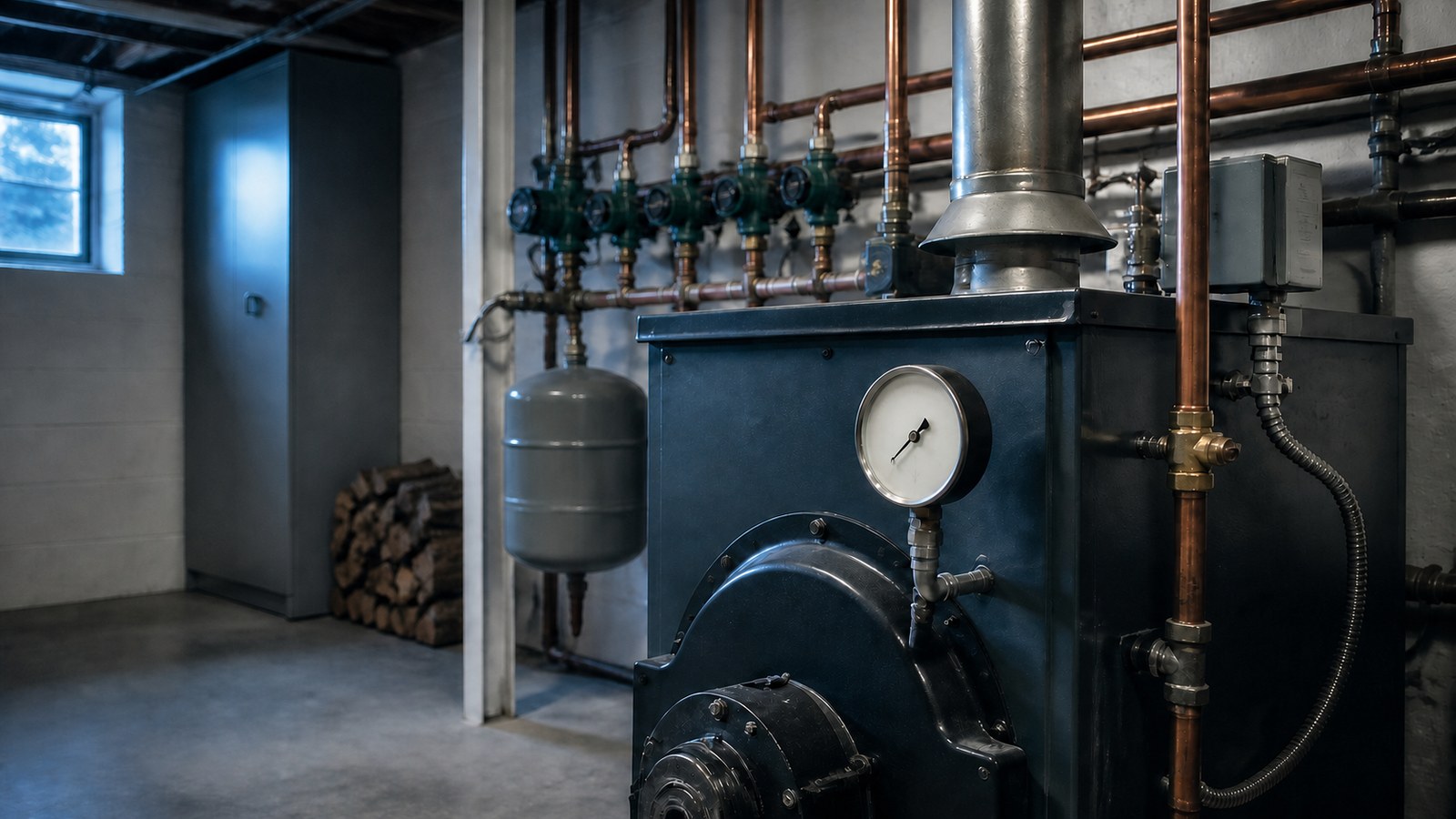
Old is not the same as finished. A cast iron boiler from the 1970s can be perfectly safe and serviceable — here is how to tell the difference, and which test actually settles it.
Age alone tells you very little
We get asked constantly whether a thirty or forty year old boiler should be replaced, and the honest answer is that age is one of the least useful inputs. Old cast iron boilers were built heavily and many are still running safely and reliably.
Compare that with a modern high-efficiency condensing boiler, which typically runs fifteen to twenty years and is considerably less tolerant of neglect. Newer does not automatically mean longer-lived.
What matters is condition, safety, and the pattern of what has been failing.
The one test that settles it: combustion and heat exchanger
This is the check that turns replacement from optional into necessary. During an annual service we test combustion, verify draught, and inspect the heat exchanger and flue.
A cracked heat exchanger or a compromised flue can put carbon monoxide into the house. That is not an efficiency question or a comfort question, it is a safety one, and it is the reason we consider an annual heating inspection genuinely non-negotiable rather than an upsell.
If that test comes back clean, an old boiler is very often worth keeping. If it does not, replacement stops being a financial decision — and we will show you what we found rather than asking you to take our word for it.
Signs that point toward replacement
- A cracked section or heat exchanger, or a failed combustion test. Decisive.
- Persistent leaking from the boiler body, as opposed to from a valve or fitting, which is repairable.
- Repairs stacking up — several failures within a couple of years, particularly of different components.
- Parts no longer available. At some point a repair becomes a scavenger hunt, and that is a real argument for replacement.
- Badly oversized for the house, often the case where a boiler was sized before insulation and window upgrades. Short cycling wears components and wastes fuel.
Signs it is worth keeping
- Clean combustion test and a sound heat exchanger.
- The failures have been controls and accessories — circulators, zone valves, aquastats, thermostats. Those are wear parts on any boiler, new or old.
- It heats the house evenly and holds temperature.
- Parts remain readily available.
One thing worth being blunt about: a single cold zone in a multi-zone house is almost never a boiler problem. It is usually a zone valve or a circulator, which is a modest repair. If someone quotes a full boiler replacement for one cold zone, get another opinion.
Does a high-efficiency boiler pay for itself?
Sometimes, and less often than the brochure implies. A condensing boiler genuinely reduces fuel use, but the payback depends on your current unit's efficiency, how much you actually spend on heat, and the installed cost including venting and a condensate drain.
Condensing units also require the right conditions to condense — they work best with lower return water temperatures, which suits modern baseboard and radiant far better than a system designed for high-temperature operation. Installed on the wrong system, a high-efficiency boiler often fails to deliver the efficiency it was bought for.
We will run the comparison against your actual system rather than assuming the newest technology is automatically right for your house.
If you are replacing, get the sizing right
The most common mistake in boiler replacement is matching the size of the old unit. That old unit may itself have been oversized, and the house has likely changed since — insulation, windows, maybe an addition.
Correct sizing comes from a heat loss calculation on the actual building. An oversized boiler short cycles, which wastes fuel, wears components and heats less evenly than a correctly sized one. Bigger is not safer here.
Need a hand with this?
We cover all of North Jersey and answer emergency calls 24/7. Call (201) 675-0147 or send us the details.
Last updated May 19, 2026. Written by JM Plumbing, Heating & Cooling LLC, NJ Plumbing Lic. #8706.