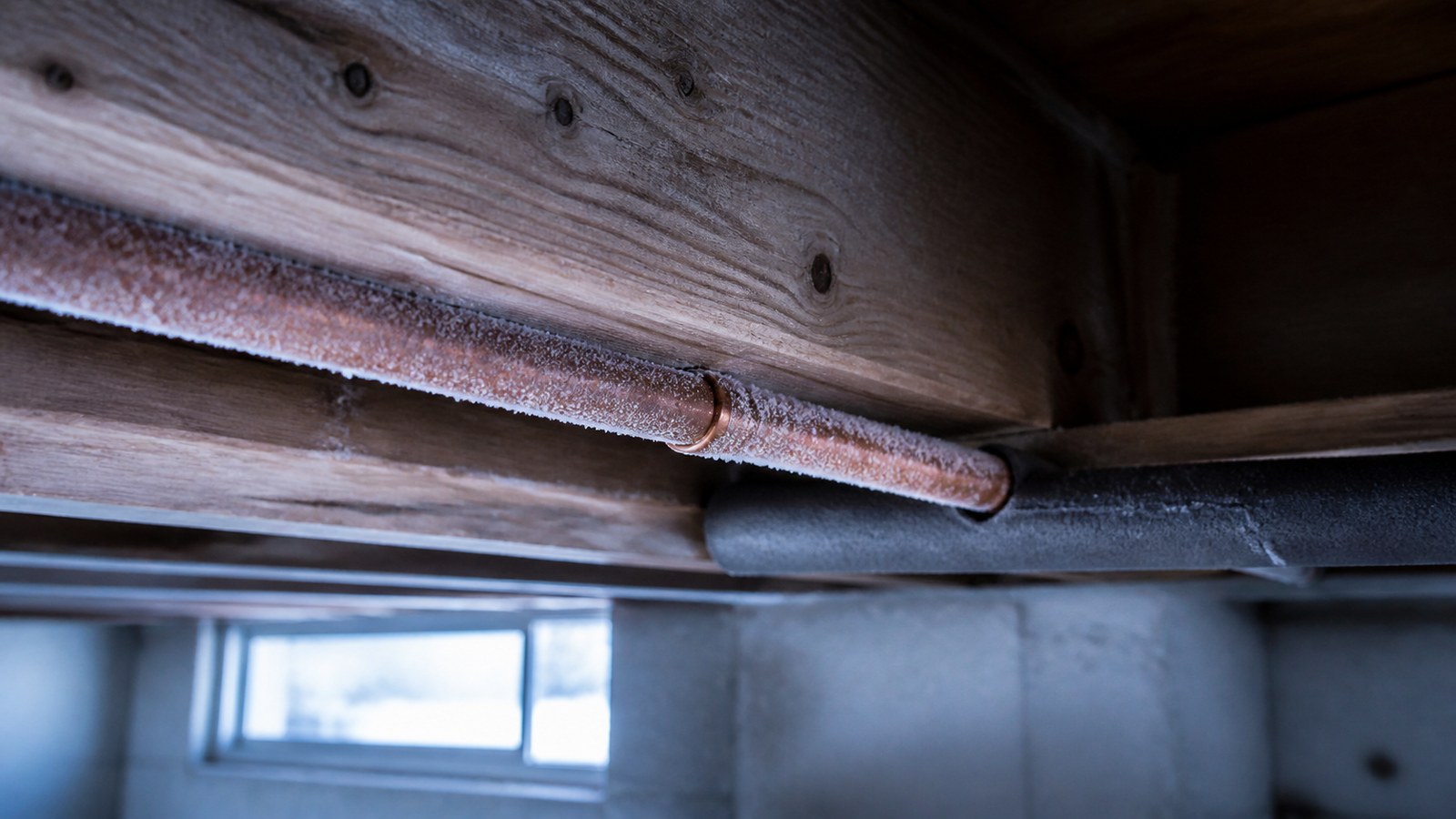
Frozen pipes are the most preventable emergency we get called for, and the most expensive when nobody prevents them. Here is what actually freezes, why, and what to do the moment one lets go.
Why pipes burst (it is not the ice)
A frozen pipe does not usually split where the ice is. Water expands as it freezes, and that expansion pushes a growing column of pressurised water down the pipe toward the closed faucet. The pipe fails at the weakest point in that trapped section, which is often several feet away from the actual blockage.
This matters for two reasons. First, the damage often appears somewhere you were not watching. Second, and more usefully: opening a faucet relieves that pressure. A trickle of moving water gives the expansion somewhere to go, which is why the old advice about letting taps drip actually works.
The pipes that freeze first
In the homes we work on across Bergen and Passaic County, the same handful of runs freeze over and over:
- Exterior wall runs — particularly kitchen sinks on an outside wall, where the cabinet blocks warm room air from reaching the pipe.
- Crawlspaces and unheated basements — common in older and hillside properties in Mahwah, Ringwood and the western part of the county.
- Rooms built over an unheated garage — the floor cavity gets outside air from below all night.
- Attic runs, usually from a later bathroom addition.
- Outdoor hose bibs left connected to a hose, which traps water in the valve body.
Notice how many of those are consequences of a renovation rather than the original build. Additions and converted spaces are where plumbing gets run through places the original builder never heated.
Prevention that is actually worth doing
In rough order of value for money:
- Disconnect every garden hose before the first freeze. This is free, takes five minutes, and prevents one of the most common burst locations. If you have frost-proof sillcocks, they only work with the hose disconnected.
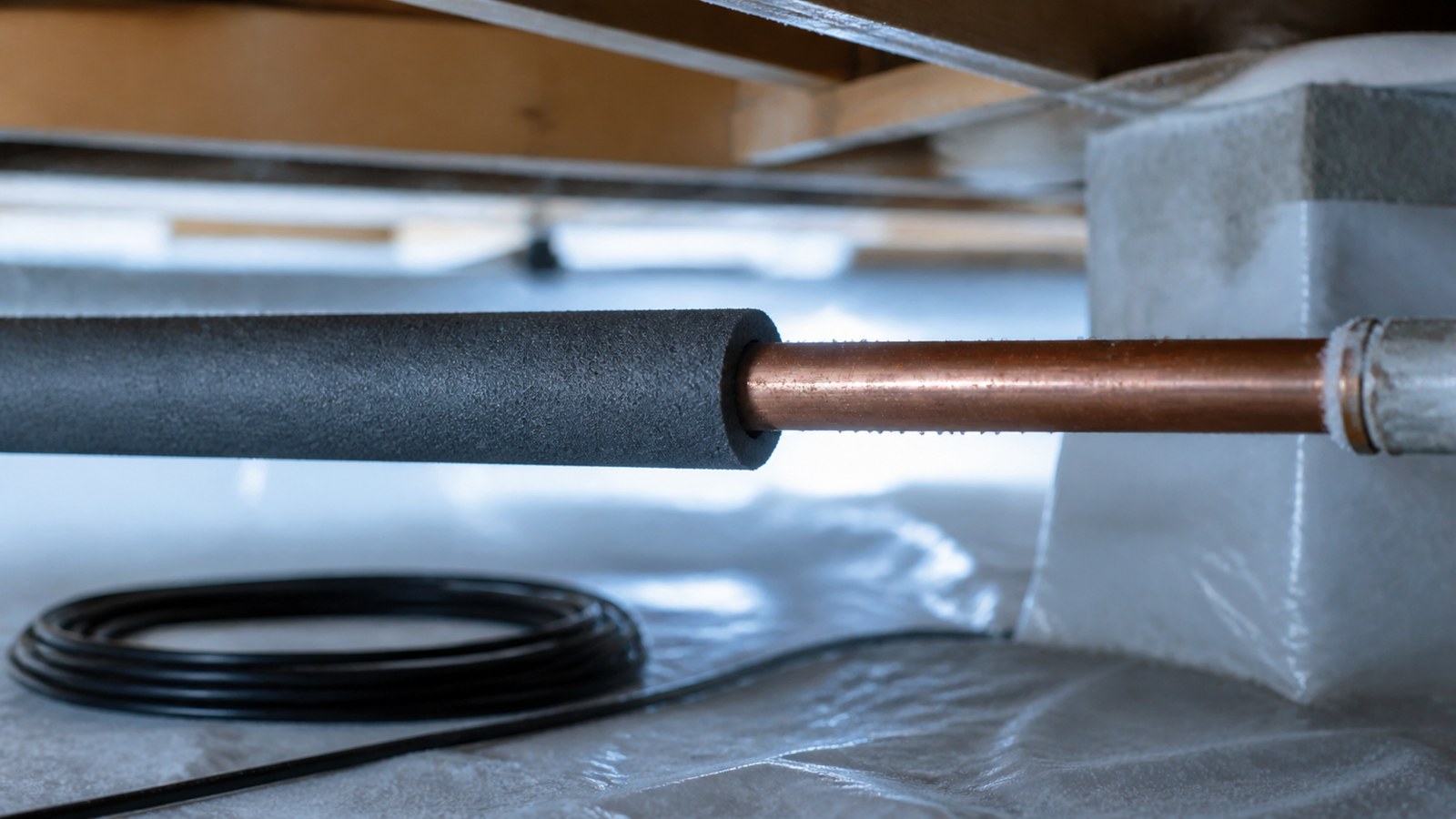
- Insulate the exposed runs in crawlspaces, garages and unheated basements. Foam sleeve is cheap. Get the joints and elbows too — those are usually left bare and they are where it starts.
- Air-seal before you insulate. A pipe in a crawlspace with a gap letting outside air blow directly across it will freeze through insulation. Find the draught first.
- Heat tape on genuinely exposed runs, correctly rated and installed. Not as a substitute for insulation — as a supplement where insulation is not enough.
- Keep the house at 55°F minimum, even when away. The savings from setting back to 45°F are trivial next to one burst pipe.
Before a hard freeze
When the forecast drops well below freezing, especially with wind:
- Open cabinet doors under sinks on exterior walls so room air reaches the pipes.
- Let the tap furthest from your main run a pencil-thin trickle overnight — cold side is enough.
- Leave interior doors open so heat moves through the house.
- If the garage has plumbing in it, keep the garage door shut.
If you are leaving the house empty for more than a few days in deep winter, the safest option is shutting off the water at the main and draining the system. It is a small job and it removes the risk entirely.
If a pipe freezes but has not burst
You will notice it as no water, or a thin dribble, at one fixture while the rest of the house is fine. Act quickly — the longer it stays frozen the more likely it splits.
- Open the affected faucet so meltwater can escape and pressure can release.
- Warm the pipe from the faucet end backward, using a hair dryer, heat gun on low, or towels soaked in hot water.
- Keep going until full flow returns, then leave it trickling until temperatures rise.
Never use an open flame — no blowtorch, no propane heater aimed at a wall cavity. Every year fire departments in this area respond to house fires started by someone thawing a pipe. It is also worth knowing that a torch on a soldered joint will simply melt it open.
If it has already burst
Speed matters more than anything else here, because water is entering the structure by the minute.
- Shut the main water valve. In most homes here it is in the basement on the street-facing wall, near the meter. Turn clockwise until it stops.
- Open the lowest faucet in the house to drain remaining pressure.
- Cut power to the affected area at the breaker if water is anywhere near outlets, fixtures or the panel.
- Call us on (201) 675-0147. We answer emergency calls around the clock.
- Photograph everything before cleanup — your insurer will want it.
Find your main shutoff now, while nothing is wrong, and make sure it actually turns. A valve that has not moved in twenty years sometimes will not, and discovering that at 2am with water pouring through a ceiling is a bad way to learn.
Need a hand with this?
We cover all of North Jersey and answer emergency calls 24/7. Call (201) 675-0147 or send us the details.
Last updated January 6, 2026. Written by JM Plumbing, Heating & Cooling LLC, NJ Plumbing Lic. #8706.