Tankless water heaters are excellent for some houses and a waste of money in others. Here is how to work out which one yours is, without the sales pitch.
How each one actually works
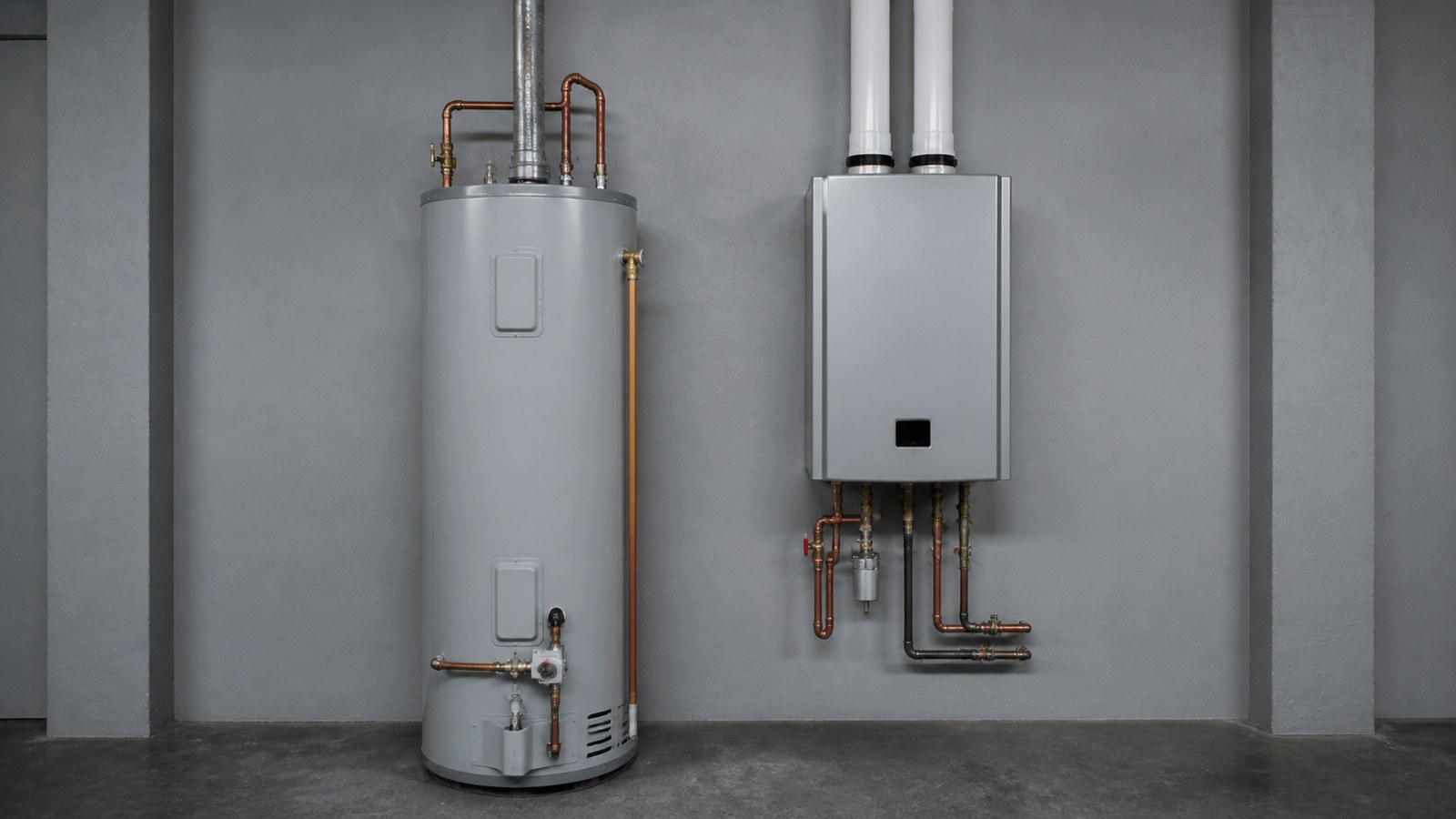
A tank heater keeps 40 to 75 gallons hot around the clock, ready for whenever you want it. Simple, proven, cheap to install, and it loses some energy continuously keeping that reservoir warm.
A tankless heater heats water only as it flows, using a much more powerful burner. Nothing is stored, so nothing is lost standing by, and you cannot run out. The trade is a considerably more involved installation and a higher purchase price.
Where tankless genuinely wins
- You keep running out of hot water. This is the real headline benefit. A tankless unit supplies indefinitely, so back-to-back showers stop being a scheduling exercise.
- You want the floor space. A wall-mounted unit the size of a carry-on frees up a corner of the basement, which matters in the tighter utility spaces common in older homes here.
- You plan to stay in the house. Tankless units last fifteen to twenty years against eight to twelve for a tank, so the longer horizon is where the economics work.
- Lower standby losses. Real, though usually a more modest saving than the marketing suggests.
Where a tank is the better decision
- Your current hot water is adequate. If nobody in the house is running out, you are paying a premium to solve a problem you do not have.
- Budget matters now. Installed cost for a tankless conversion is typically two to three times a like-for-like tank swap, because of venting and gas line work.
- Your gas line cannot support it. Tankless units need substantially more gas flow while running. Many older homes need the line upsized, sometimes back to the meter.
- Simultaneous heavy demand. A tankless unit is limited by flow rate. Two showers plus a dishwasher can exceed what a single residential unit delivers, whereas a big tank simply empties more slowly.
- You want simple. Tankless units are less forgiving of neglect and need annual descaling, particularly on hard water.
The installation is the part people underestimate
Swapping a tank for a tank is usually a half-day job. Converting to tankless is a different scope:
- New venting. Tankless units vent differently and usually need a new penetration through the wall.
- Gas line upsizing, often the single biggest cost driver, and sometimes a run all the way back to the meter.
- Condensate drain for condensing models.
- Electrical supply for the controls and igniter.
- Permits and inspection, which apply to both but involve more scope on a conversion.
Any quote for a tankless conversion that does not address venting and gas supply is not a complete quote.
Hard water changes the maths
Much of our service area has moderately hard water, and parts of Mahwah, Ringwood and West Milford have properties on wells where it is harder still. Scale is the main enemy of a tankless heat exchanger.
On hard water a tankless unit needs annual descaling to hold its rated output and reach its expected life. Skipping it is how a twenty-year unit becomes an eight-year unit. If you are going tankless on hard water, budget for either a softener or yearly service.
Our actual recommendation
Choose tankless if you are running out of hot water, you want the space back, you are staying put, and the gas supply is workable.
Choose a quality tank if your hot water is fine, you want the lower up-front cost, or the gas and venting work would add substantially to the job for benefits you would not really use.
There is no universally right answer, which is why we price both on request. Anyone who recommends tankless before looking at your gas line and asking how often you run out is selling, not advising.
Need a hand with this?
We cover all of North Jersey and answer emergency calls 24/7. Call (201) 675-0147 or send us the details.
Last updated March 10, 2026. Written by JM Plumbing, Heating & Cooling LLC, NJ Plumbing Lic. #8706.