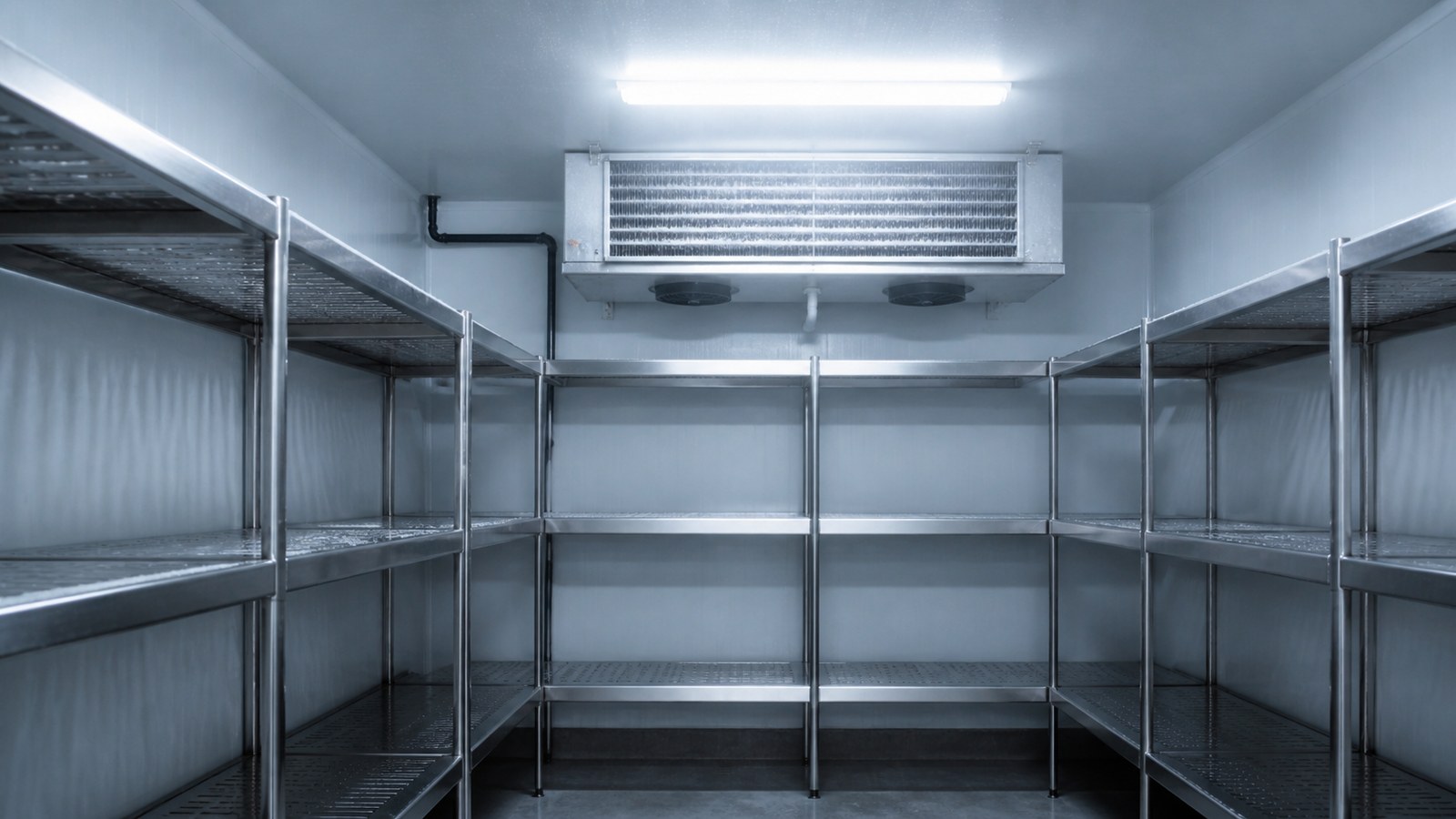
When a walk-in starts climbing, you are on a clock measured in product value. Here are the checks worth running in the first five minutes, and the ones that need a technician.
First: how fast is it climbing?
Before anything else, note the current box temperature and check it again in fifteen minutes. The rate of climb tells you how much time you have and changes what you should do first.
Climbing fast — start relocating high-value product now, in parallel with troubleshooting. Do not wait to see whether you can fix it.
Drifting slowly, a few degrees above setpoint — you likely have time to work through the checks below before it becomes a loss.
Either way, log the temperatures. If you end up making an insurance claim or answering a health inspector, that record matters.
Check 1: the door
Genuinely the most common cause, and the most commonly overlooked. Check that the door is fully closed and latching, that nothing is propping it, and that the gasket seals along its whole length.
Close the door on a dollar bill and pull. If it slides out with no resistance, the gasket is not sealing there. Do that at several points around the frame.
A torn or hardened gasket makes the unit run continuously fighting infiltrating warm air, which drives energy cost up, ices the coil, and shortens compressor life. Gasket replacement is inexpensive relative to what it prevents.
Check 2: ice on the evaporator coil
Look at the coil inside the box. A coil buried in ice cannot move air or absorb heat, so the box warms up while the unit appears to be running normally.
Ice usually means a defrost problem — a failed defrost timer, heater or termination thermostat — or warm humid air getting in past a bad gasket or a propped door.
Shutting the system down to let the coil thaw will restore temporary cooling, but the ice will return until the underlying cause is fixed.
Check 3: the condenser coil
The condenser is the outdoor or remote coil that rejects heat. In a commercial kitchen it fouls quickly with grease and dust, and once it cannot shed heat, the system cannot cool no matter how hard it runs.
Look for a visibly dirty or greasy coil, blocked airflow around the unit, or a condenser fan that is not turning. A dirty condenser is the single most preventable cause of refrigeration failure, and cleaning it is routine maintenance.
Check 4: controls and airflow
Confirm the thermostat setpoint has not been changed. Check the unit has power and no breaker has tripped.
Then look at how the box is loaded. Product stacked against the evaporator or blocking the air path stops circulation, which produces warm spots and a box that never reaches setpoint even though the equipment is working correctly.
When it needs a technician
Call for service if you find any of the following:
- The compressor is running constantly and the box still will not hold temperature
- The compressor short cycles — starting and stopping every few minutes
- Ice keeps returning after thawing
- Oily residue near fittings or coils, which suggests a refrigerant leak
- Unusual noise from the compressor
- The unit is tripping breakers
One point worth being clear about: a system low on refrigerant has a leak. Refrigerant is not consumed. Anyone who simply tops it off each season is charging you repeatedly to vent refrigerant into the atmosphere instead of repairing the fault, and how commercial refrigerant is handled and documented is regulated.
Preventing the next one
Refrigeration failures are rarely sudden. Coils foul gradually, gaskets harden, superheat drifts, and the box works a little harder each month until something gives — usually during a heat wave or a holiday weekend, which is exactly when service is hardest to get and product loss is highest.
Scheduled maintenance covers condenser and evaporator cleaning, temperature and defrost verification, gasket inspection, electrical checks and refrigerant charge. For a busy kitchen, quarterly is realistic; twice a year suits most other boxes.
We service walk-in coolers and freezers across North Jersey and answer emergency refrigeration calls 24/7 — because product does not wait for business hours.
Need a hand with this?
We cover all of North Jersey and answer emergency calls 24/7. Call (201) 675-0147 or send us the details.
Last updated June 23, 2026. Written by JM Plumbing, Heating & Cooling LLC, NJ Plumbing Lic. #8706.